CNC machining RFQ drawing requirements
Prepare a STEP or IGES model with a matching PDF drawing, then identify the material, quantity, critical features, finish, required documents and delivery country. Together, these describe the part to be quoted and the condition in which you need it supplied.
If details are still open, you can begin with a useful part description and quantity estimate. Use the checklist below to separate known requirements from questions that need discussion.
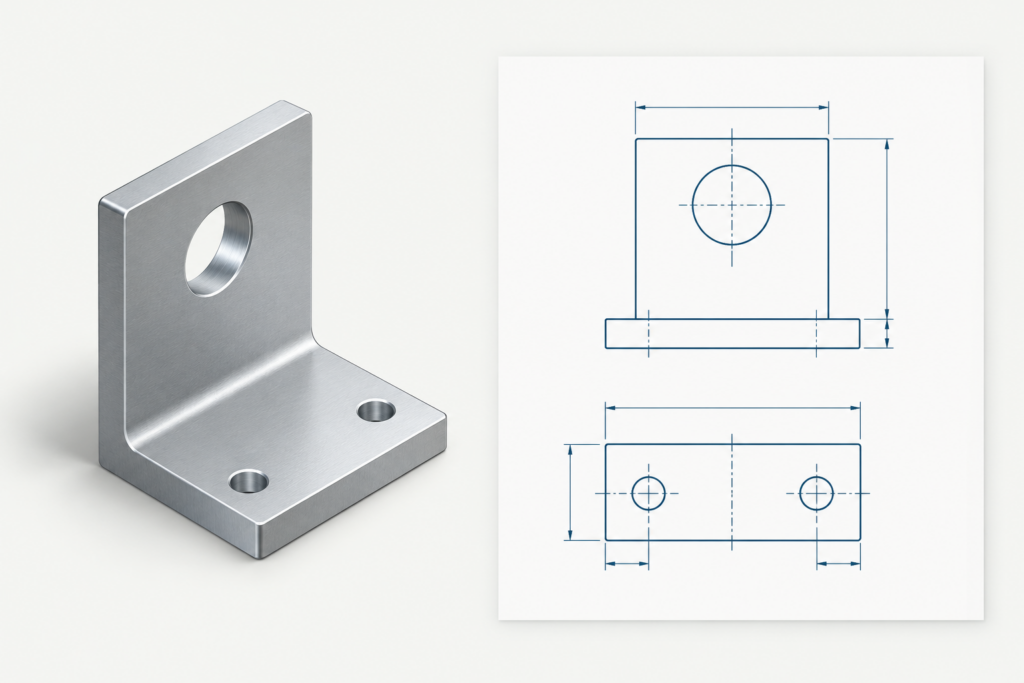
AI illustration of a model and drawing. Manufacturing dimensions and project-specific callouts are not shown.
Pair the geometry with the manufacturing requirements
3D model: the part geometry
STEP or IGES provides an exchange model for assessing the shape and machining route. Export the intended revision from your CAD system, reopen the exported file and check that the required geometry is present. Identify the units rather than relying on a filename or scale assumption.
PDF drawing: the controlled requirements
Use the 3D model to communicate geometry and the PDF drawing to identify the dimensions, tolerances, threads and finishes that need to be controlled. Include readable views, sections or details where an internal feature or interface would otherwise be unclear.
Give the files the same part identity and revision. If the model and drawing disagree, identify the discrepancy and confirm the controlled revision before the manufacturing scope is agreed. A matching filename alone does not establish that the contents agree.
Six checks before sending your RFQ
01 — Material and condition
Specify the grade and condition, with the material standard and stock form where relevant. For example, “6061-T6 plate” conveys more than “aluminium”. Identify any required brand or permitted alternatives. If the material is undecided, explain the part’s use and operating conditions so that options can be discussed.
02 — Quantity and purchasing stage
List the quantity for each part and any price-break quantities you want compared. Separate the prototype requirement, first batch and expected repeat demand. An estimated annual quantity is useful context; it is different from the quantity being ordered now.
03 — Critical dimensions and features
Identify the dimensions and datum relationships that control fit, alignment or sealing. Distinguish a hole’s fit from its position. For threads, state the designation, tolerance class where required and usable thread depth; a blind drilled depth is a separate dimension. Unspecified dimensions need an agreed general-tolerance basis before manufacture, rather than one blanket precision claim for every feature.
04 — Finish and finished-part condition
Name the finish and any appearance requirements, including visible faces, colour and relevant texture or roughness. State whether critical dimensions apply before or after finishing, and identify any surfaces or threads that must be masked. Include edge and burr requirements where they affect assembly or handling.
05 — Inspection and documents
Specify whether you need a key-feature report, full dimensional inspection, material documents or first-article records; the agreed document scope belongs in the quotation. These are different deliverables. Identify the features to be reported and any required format or material-document type, rather than assuming every part includes the same certificate package.
06 — Delivery country and required date
Give the destination country and explain whether your date means ready for dispatch or required arrival. Add packing or part-identification requirements that affect the delivery. Manufacturing, transit and customs stages need to be considered separately when the quotation and schedule are agreed.
Keep each part matched to its files
For each part, list its revision, matching drawing and model filenames, material condition, quantity and finish. Keep that list with the files so that quantities or materials cannot be transferred accidentally between components.
The entries below are illustrative examples. Replace them with your own part information; the actual drawing defines the component and its acceptance requirements.
Example: RFQ-101 / Rev A
Drawing: RFQ-101_A.pdf
Model: RFQ-101_A.step
Material: 6061-T6 plate
Quote quantities: 10 and 50 pieces
Finish: clear anodising, with functional masking defined on the drawing
Example: RFQ-102 / Rev B
Drawing: RFQ-102_B.pdf
Model: RFQ-102_B.step
Material: 316L bar
Quote quantities: 20 and 100 pieces
Finish: deburred, with the surface requirements defined on the drawing
These are per-part quantity tiers. If one part changes revision, update its drawing, model and list entry together. Remove superseded files from the package or identify them clearly as reference-only.
Put the package into the quote form
Upload PDF drawings and ZIP files containing STEP or IGES models: up to 3 files, 10 MB per file. The file picker accepts PDF and ZIP; place the CAD models inside a ZIP rather than selecting individual STEP or IGES files.
For the two-part example, you could send the two PDFs and one ZIP containing the models and part list, provided each uploaded file stays within the size limit. Alternatively, keep the complete, clearly named package in one ZIP.
Use the existing fields
Name, Work email and Project requirements are required. Material, Quantity tiers and Delivery country have their own optional fields; use them for the corresponding checklist information. Add the part’s purpose, critical-feature questions, finish, document needs and required date to Project requirements when these are not already clear in the attachments.
Start without files or arrange an NDA first
You can start an enquiry without files if details are still open or your files do not fit; describe the part and agree a suitable way to exchange them.
If you need an NDA, request contact to arrange it before sharing technical files. The form’s NDA contact option starts that discussion; selecting it does not execute an agreement.